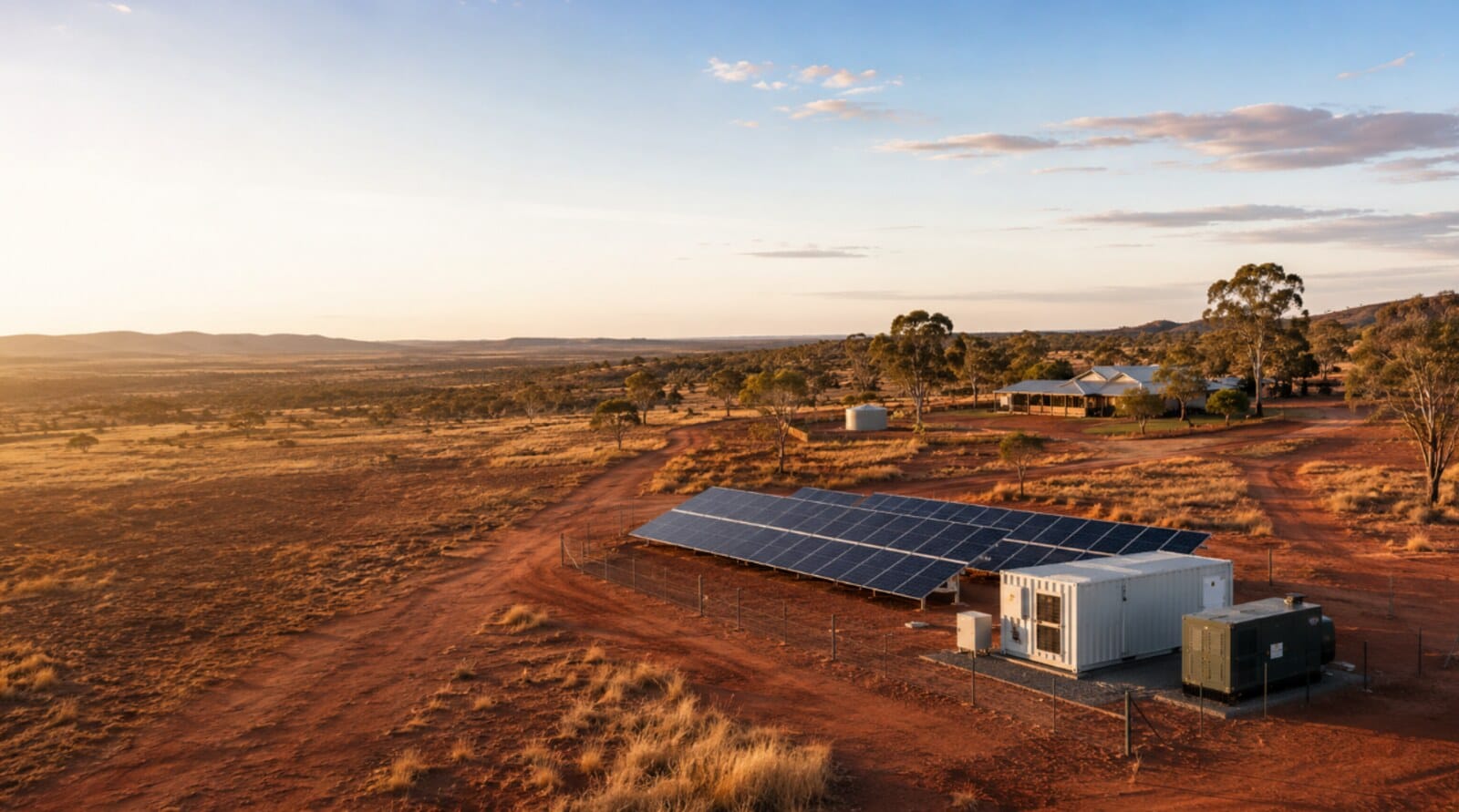
Stand-alone power equipment at a remote station
Remote agriculture · Queensland & NSW

Off-Grid Power Systems for Farms and Remote Agricultural Operations

Stand-alone solar, battery and generator systems built around the realities of remote agricultural operations — from pumping and livestock infrastructure to processing and essential site power.

Request an Energy Assessment

01Critical loads first

02Battery autonomy

03Generator integration

Solar array and power equipment at a remote station
Stand-alone power

Power where the grid is not a practical option.

  • A stand-alone power system (SAPS) supplies a site independently of the electricity network.
  • Solar PV generates energy, BESS stores it, and a generator can support demand during low-solar periods or high-load operation.
  • The controls and electrical interfaces are as important as the individual components.
  • Remote farms and stations, irrigation facilities, livestock water systems and other critical agricultural infrastructure require site-specific load analysis.
  • Existing diesel systems may be integrated into a solar and battery hybrid rather than simply replaced.
The SAPS architecture

Generation. Storage. Control. Essential power.

A stand-alone system is coordinated as a whole. Battery reserves, generator operation and load priorities must work together across normal operation and low-solar periods.

Conceptual diagram · not an electrical design

Solar PVDaytime generation
Backup generatorLow-solar periods & high demand
Hybrid inverter & controlsCoordinate generation, storage & supply
Battery storage (BESS)Operating reserve & battery autonomy
Critical loadsWater · livestock · essential site power
Discretionary loadsPrioritised by the agreed control strategy
Monitoring & alarms inform the operating strategy. Battery energy can flow to or from the system; essential and discretionary loads are prioritised by site-specific controls.
Illustrative relationships only. Not a wiring diagram, equipment specification, switching scheme or guarantee of uninterrupted supply. Protection, controls and equipment selection require engineering review.
01

Three-phase loads & motor starting

  • Pumps, mills, compressors and workshop equipment can draw high starting currents.
  • Inverter capability, generator sizing, starting methods and protection must be reviewed together.
02

Battery autonomy

  • Usable storage depends on the load profile, operating reserve, temperature and allowable depth of discharge.
  • Model overnight demand and low-solar periods rather than promise a fixed number of battery-only days.
03

Generator integration

  • Review generator condition, minimum loading, start/stop controls, synchronisation and charging strategy.
  • A hybrid controller must coordinate generation and storage without compromising essential loads.
04

Monitoring & control

  • Remote monitoring should expose system status, alarms and performance trends.
  • Communications availability and local operation when connectivity fails need to be part of the design.
05

Redundancy & critical loads

  • Separate essential and discretionary loads, define backup arrangements and plan failure response.
  • Redundancy is a site-specific engineering decision, not an automatic guarantee of uninterrupted supply.
06

Maintainability

  • Equipment access, heat, dust, weather exposure, spare parts, fuel logistics and operator capability affect long-term supportability.
  • Plan service access and safe isolation before equipment is procured.
Assessment to commissioning

One delivery pathway. Site-specific decisions.

JSL Energy provides end-to-end project delivery and turnkey EPC solutions for commercial agricultural solar, battery storage and hybrid energy systems. We coordinate specialist engineering, procurement, construction and commissioning partners to deliver an integrated solution under an agreed project scope.

  1. 01

    Assess the site & energy use

    • Start with the location, interval data or generator logs, bills, equipment list and operating schedule.
    • Identify supply constraints, critical loads and the business objective.
  2. 02

    Profile & compare options

    • Review daily and seasonal demand, motor starts, solar resource, battery use and generator operating patterns.
    • Compare grid-connected, hybrid or stand-alone options against site requirements.
  3. 03

    Coordinate engineering & design review

    • Define scope, interfaces, protection, controls, connection requirements and constructability.
    • Coordinate the relevant engineering disciplines and specialist suppliers for the agreed project.
  4. 04

    Deliver & commission

    • Coordinate procurement, delivery, site interfaces and quality checks.
    • Confirm functional performance, operating settings and handover requirements through commissioning and documentation.
Queensland & NSW

Regional and remote project support.

  • JSL Energy is based in Burleigh Waters, Queensland, and works across regional and remote Queensland and New South Wales.
  • Project availability, travel, site access and specialist support are confirmed when the scope is reviewed; this is not a promise of local offices or coverage at every location.

Related capabilities

Start with the load

Request an Energy Assessment

Share your site location, operation, energy issue and available bills or generator information using the existing agricultural enquiry form. The initial desktop assessment is no-cost. Engineering, site visits and implementation are separately scoped and priced.

Request an Energy Assessment